

Gnaoua Festival Berlin No2
Wednesday 14.08.2019 10am | Club
Admission: free
Organizer: Werkstatt der Kulturen
Production
MASTERCLASS
MASTERCLASS with MAJID BEKKAS & ALY Keïta
14-15/082019 | 10am | Club
free event
Registration required for professional musicians only.
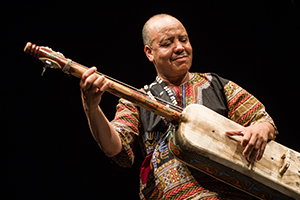 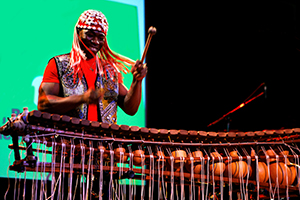 |
After the 1st festival the event is already iconic, we present the Gnaoua Masterclass with Mâalem Majid Bekkas.
The gimbri and oud player Majid Bekkas, who received numerous awards, is one of the international stars of the Moroccan music scene and is known to a large audience in Germany because of his collaborations with Joachim Kühn and Klaus Doldinger. The trio of Majid Bekkas, Joachim Kühn and Ramón López have released five successful, award winning albums on the renowned Jazz label ACT. The GNAOUA FESTIVAL BERLIN would like to establish the Masterclass as a recurring feature for the benefit of the Berlin music scene. This year, the charismatic Majid Bekkas is setting new musical priorities as a coach. He is supported by his long-time collaborator Aly Keïta (Balafon), the star of sub-Saharan music in Berlin. Over a period of two days, both Mâalems - both masters - will collaborate on new songs in a music lab with professional musicians from Berlin. The result will be presented to the audience in this concert.
|
GNAOUA FESTIVAL BERLIN No2
They came from West African countries now called Mauritania, Senegal, Niger and Mali, many of them from Western Sudan. For centuries, West Africans, often still children, were kidnapped, enslaved and deported by caravan trade routes to today's Maghreb states. In the 16th century, one of the largest centres of trans-Saharan human trafficking was in Morocco, about 150 kilometres from Marrakech.
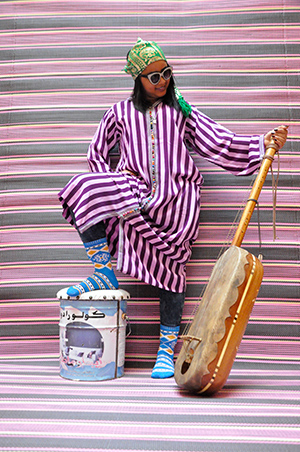 |
Today Essaouira is one of the most important cultural centres of Gnaoua. There are various assumptions about the origin of the term »Gnaoua«. It was probably derived from the Arabic »Guinea«, i.e. »black«. A derivation from the Berber akal n iguinaouen, »land of blacks«, is also possible. The »Gnaouis«, the black Moroccans, trace their cultural origins back to the Hausa from states such as today's Benin, Nigeria, Cameroon and Niger, the Peul, whose principalities stretched from Guinea, Senegal, Mauritania, Mali and Chad to Sudan, the Wolof culture in Senegal, Gambia and Mauritania, and above all to the Bambara and Songhai, whose empires concentrated around Niger and shaped the regions linguistically and culturally from the 15th to the 17th century. The Gnaouis blended the spiritual music of these very different West African cultures of origin with Sufi traditions and musical styles of the Jewish and Muslim Arabs and Amazigh North Africans. The outcome is a resilient, spiritual music and a curative practice, the Gnaoua culture, whose musical core is the driving rhythm of the metal »qraqeb«, the predecessor of the flamenco castanets. |
The UNESCO is considering including Gnaoua music in the Representative List of Intangible Cultural Heritage in December 2019.
The GNAOUA FESTIVAL BERLIN No2 is presented by

The Partners


Our special thanks to Jörg Grotjohann, Cultural Attaché of the German Embassy in Rabat, for his kind assistance.
|
|
|
