
The WERKSTATT DER KULTUREN celebrates its 25th birthday!
To celebrate the jubilee, we are presenting Moroccan trance music, the music of the Gnawa people at WERKSTATT DER KULTUREN.
On the festival programme:
great masters from Morocco, new diasporic voices of the Gnawa and collaborations with Berlin’s world jazz scene.
Free admission
|
The 1st GNAOUA FESTIVAL BERLIN celebrates the legendary trance-like music of the Gnawa. The Gnawa people are descendants from West Africans, abducted in the 11th century from countries known today as Mauritania, Senegal, Niger and Mali, and enslaved in the Maghreb. In the North African diaspora, they used a variety of West African sacred music as a practice of resistance and infused it with Sufi traditions and musical styles of the Arabs, Jews and Berbers. This music’s high emphasis on rhythm not only redefined the sound of Morocco, Algeria and Tunisia, but also had a great influence on the international development of jazz: Starting in the 1960s, renowned US jazz musicians such as Randy Weston, Archie Shepp and Joe Zawinul became interested in the trance music of the Gnawas and performed with great Mâalems (Gnawa masters). Rock stars such as Jimi Hendrix, Led Zepplin and Carlos Santana were also inspired by Gnawa music. |
Festival curator: Alaa Zouiten
The ‘Blues of Morocco’
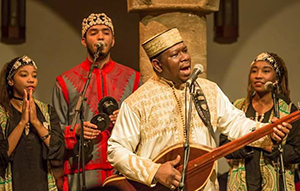
The West Africans abducted to the Maghreb merged and syncretised their musical styles, languages and religions with different North African cultures. They introduced instruments that still shape the sound of Gnawa music today: e.g. the Guembri, a three-string bass lute strung with goatskin with which the Mâalem (Gnawa master) commences singing, or the metal Qraqebs, predecessors of the Flamenco castanets that produce the polyrhythmic groove of Gnawa. In the diaspora, the Gnawas combined the pentatonic melodies, call-and-response chants and complex rhythms of West Africa with the local musical traditions of the Arabs, Jews and Berbers. Although the Gnawas were ostracized as a subculture in the Maghreb and therefore stood on the fringes of society, their influence on North African music is immense: for example, the 1970s cult bands Nass el Ghiwane and Jil Jilala (dubbed the "Rolling Stones of Morocco"), who combined Gnawa with other popular styles and socio-critical texts, are still almost mythically revered throughout the Maghreb today.
Gnawas, Trance & Therapy
In addition to music, the therapeutic background of the Gnawa culture is also fascinating: the Gnawas have always used the hypnotic effect of their music for healing ceremonies reminiscent of Haitian Vodoun, Brazilian Candomblé or Cuban Lucumi, which are also of West African origin. Lilas, nocturnal ceremonies that often end at dawn, are held for suffering of all kinds. Music and dance awaken different spirit forces (Mlouks). The aim is to put the "patient" into a trance so that he can connect with the healing spirits.
Program
- 16.08.2018 | The Arab Song Jam feat. Majid Bekkas
- 17.08.2018 | Gnaoua Workshop with Master Simo Lagnawi
- 17.08.2018 | Gnaoua Parade
- 17.08.2018 | From the Tree to the Plucking of Stringsom
- 17.08.2018 | Black Koyo
- 17.08.2018 | Simo Lagnawi
- 18.08.2018 | Aesthetics, Ethics and Trance in the Culture of Gnawa
- 18.08.2018 | Festival-Band "Master Class"
- 18.08.2018 | Gnawa Deutschland
- 18.08.2018 | Mâalem Mokhtar Gania
- 16.-18.08.2018 | Trance of Words
THE ARAB SONG JAM featuring Majid Bekkas "Gnawa Art Trio"
16.08.2018 | 7.30pm
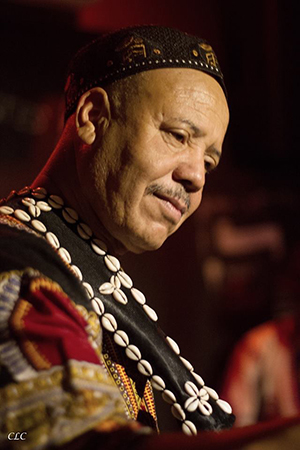
Majid Bekkas, originator and worldwide ambassador of the "Gnawa Blues", already shared the stage with saxophone giants Archie Shepp and Pharaoh Sanders. The "Ali Farka Touré of Morocco" with saxophonist Mohamed Babarti and the young talented Moroccan percussionist Amin El Bliha, will perform.
Their repertoire includes traditional Gnawa music as well as their own compositions, which are inspired by rhythms and melodies from different corners of Morocco and enriched with artistic improvisations.
Every month, during the second set of "ARAB SONG JAM goes Maghreb", musicians from the Arab music scene who are based in Berlin are invited to jam. "ARAB SONG JAM goes Maghreb" - the sounds from West Asia and North Africa were featured in the New York Times: "Jazz it up: Arab musicians bring their songs to Germany". We expect a vibrating jam session à l´arabe!
In 1957 Majid Bekkas, oud and guembri virtuoso and guitar professor, was born in Salé (Morocco). He is considered the creator of the "Gnawa Blues" and for decades has been its musical ambassador all over the world. The "Ali Farka Touré of Morocco" is a multi-instrumentalist and an authority of African music - especially of Mali's musical culture.
The world music fair WOMEX says: "Bekkas openness and his unique ability to uncompromisingly combine modernity and historical awareness free his music from the shackles of time".
|
|
Bekkas studied classical guitar and oud at the Conservatory of Music and Dance in Rabat, after which he learned the art of guembri and Gnawa music from Mâalem Ba Houmane. He has made a name for himself internationally by collaborating with great African musicians such as the balafonist Aly Keita, the N'goni player Bassekou Kouyaté and the Kora player Ablaye Cissoko as well as through numerous concerts and CD recordings with jazz stars including Pharoah Sanders, Archie Shepp, Joachim Kühn, Louis Sclavis and the Big Band of the Hessischer Rundfunk. He received the Django d´Or 2004 for his album "Mogador" with the Italian jazz trumpeter Flavio Boltro. Bekkas became known to German audiences through his participation on Klaus Doldingers album "Passport to Morocco" (German Jazz Award 2006) as well as through the following big jubilee tour for Doldingers 70th birthday with more than 50 concerts in front of nearly 100.000 visitors. Majid Bekkas album "Makenba" (2010) ranked number 1 in the top 10 list of the most important Gnawa albums in the music magazine Songlines. In 2012 he was awarded the silver medal of the Academy of Sciences and Arts in Paris. |
Line-up:
Majid Bekkas - Oud/Guembri/Vocals
Mohamed Babarti - Saxophone
Amin El Bliha - Percussion
Every 3rd Thursday of the month “ARAB SONG JAM goes Maghreb" will be led by festival director Alaa Zouiten.
In the 2nd set he’ll be joined by festival curator Alaa Zouiten (Oud) and other musicians from ARAB SONG JAM at the WERKSTATT DER KULTUREN.
Gnaoua Workshop with Master Simo Lagnawi
17.08.2018 | 3.00pm
As part of the 1st Gnaoua Festival Berlin, the Moroccan - British Gnawa master and ambassador of Gnawa music culture in the UK Simo Lagnawi will be hosting a workshop for all Gnawa enthusiasts and lovers!
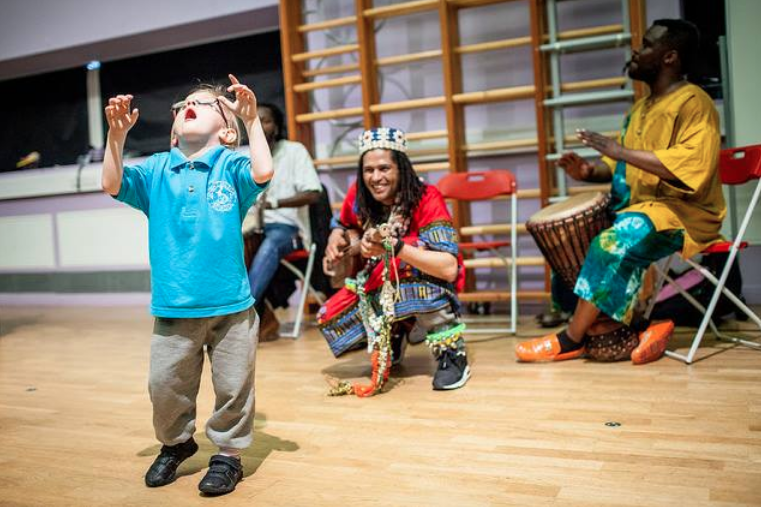 |
Learn the basics of Gnawa music culture: guembri, rhythmic patterns, qraqebs, vocals, ceremonies, etc .. Open for ALL who are interested! No matter what age (also suitable for children), no matter if you can already play a musical instrument or not. Fee: 7 Euro Registration: gnawafestival@werkstatt-der-kulturen.de (please indicate surname, first name and age) |
Gnaoua Parade
17.08.2018 | 6.00pm
The second day of the festival begins with a Gnawa parade inspired by the ftouh rahba, a procession that traditionally opens the Gnawa World Music Festival in Essaouira:
Gnawa musicians and dancers leave the WERKSTATT DER KULTUREN with Qraqebs, drums and the like for Hermannplatz in the heart of Kreuzkölln and return at 6 pm
From the tree to the plucking of stringsom
Musical Instrument Building Exhibition with Mohamed Khoudir
17.08.2018 | 7pm
On display are the most important musical instruments of Arabic Gnawa music such as the oud, guembri, qraqeb, bendir, tam tam, ...
 |
Mohamed Khoudir grew up in Algeria and has been living in Berlin for almost 20 years. Among other things, he has trained as an educational teacher and music sound therapist. |
Black Koyo
17.08.2018 | 7.30pm
Black Koyo is a group of young exiled Moroccans who now live in Brussels.
In Morocco, these nightly ceremonies of dance, music and trance can last up to 12 hours!
|
Line-Up:
|
The members of Black Koyo come from various Moroccan cities: Fès, Meknès, Tangier and Casablanca. "Koyo" means "qraqeb player" (a castanet-like, iron percussive instrument central to Gnawa music). Due to their different regional origins, the group represents a unique blend bringing together all of the most important traditional Gnawa groups as well as their sounds, songs, dialects and dances, thus providing a unique view of the Gnawa culture. This unusual blend has already resulted in countless performances for the group, from private Lila ceremonies with famous Gnawa families in Morocco to concerts in Brussels, Germany or at the Festival des Musiques Sacrée du monde in Fès, Morocco. Hicham Bilali, the master of the group, was born in 1978 in Fez, the son of a Moroccan mother and a Senegalese father. At a young age he came into contact with the Gnawa, absorbed their culture and music and made his debut at the age of 18 alongside the great Mâalem Hamid Dkaki. He is accompanied by his Koyos, all living in Brussels and trained by renowned Mâalems. |
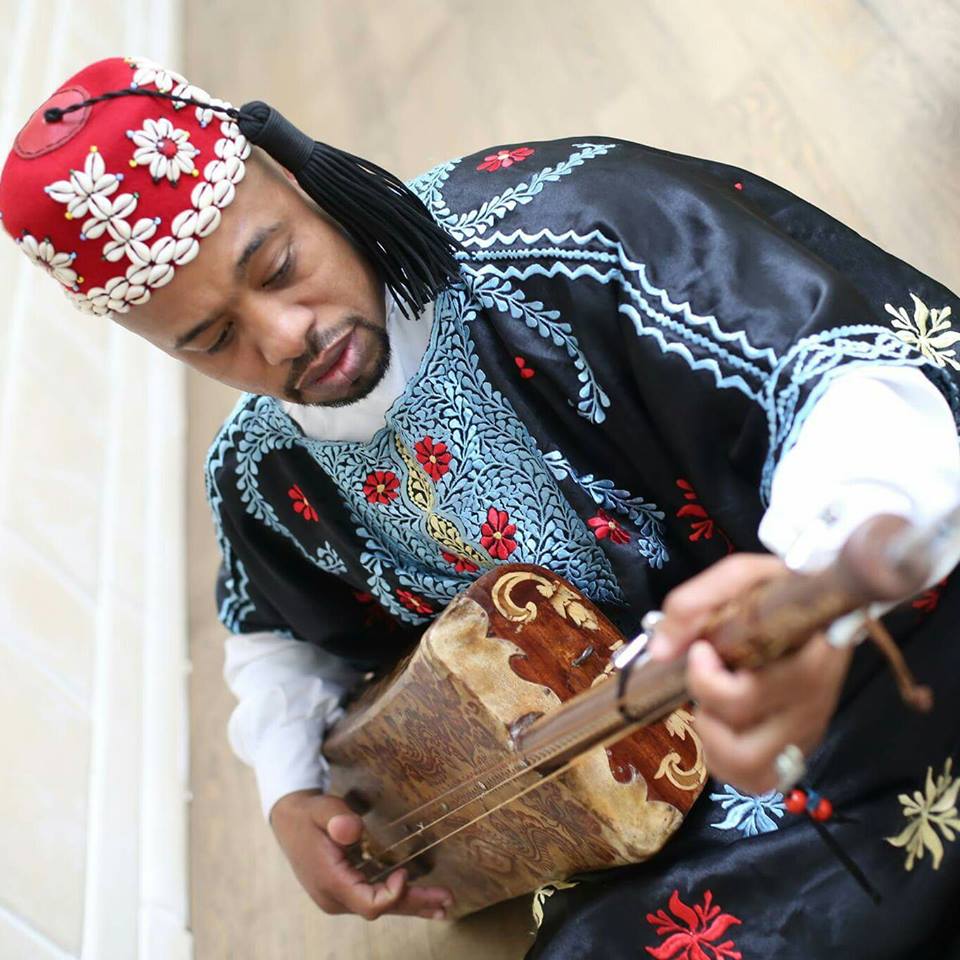
Simo Lagnawi
17.08.2018 | 9.30pm
On the second day of the festival, Simo Lagnawi (Morocco/London), a "young maverick" of Gnawa, will take centre stage. In his adopted country, Great Britain, he and his band Electric Jalaba are causing a sensation ("Loving the release, we need to get them in the studio!", BBC music journalist Gilles Peterson).
After an opening with traditional Gnawa music he shares the stage in the 2nd set with singer and multi-instrumentalist Momo Djender (Algeria/Berlin), the "innovator" of traditional Chaabi music who has already toured with Sting and Klaus Doldinger. In the 3rd set they catapult the traditional music of the Maghreb into the 21st century, accompanied by drums (Muhammad Ra´fat/, Egypt/Berlin) as well as jazz trumpet and electro loop station (Arystan Petzold/Dresden).
|
Line-up: Simo Lagnawi - Guembri, Vocals |
His debut album "Gnawa London" made it onto the top ten of the most important Gnawa albums according to music magazine Songlines. As on his follow-up albums "Gnawa Berber" and "Gnawa Caravan" he mixes the tradition of his ancestors with new influences: such as Celtic violin sounds, African-sounding banjo or the music of Gambia, Burkina Faso, Mali and the Caribbean. The track "Baniyorkoy" from his album "Gnawa London" was included in the CD compilation "Rough Guide To The Best African Music You've Never Heard". In his band "Electric Jalaba", which is highly acclaimed in Great Britain, the grooves of quembi and qraqebs meet electronic tribal beats, electric guitar and DJ turntables - without disregarding the spiritual roots of Gnawa. This dazzling mix of music has resulted in Electric Jalaba performing at numerous internationally renowned music festivals such as Fengaros (Cyprus), Rockit (Italy), Respect (Czech Republic) or the Mawazine Festival in Rabat (Morocco). |
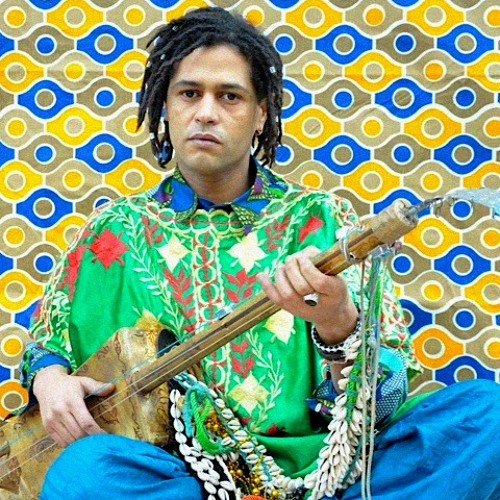
Aesthetics, Ethics and Trance in the Culture of Gnawa
18.08.2018 | 4.00pm
Music anthropologist Dr. Tamara Turner (Max Planck Institute for Human Development Berlin) will give a lecture (in English) on "Aesthetics, Ethics and Trance in Gnawa Culture" and then have a discussion with Gnawa musicians at the festival.
Dr. Tamara Turner conducts research at the Max Planck Institute for Human Development in Berlin and is a renowned Gnawa expert. She has undertaken numerous research trips to various Gnawa groups throughout the Maghreb and learned to play the guembri with various great Gnawa masters. In 2012 she completed her studies in ethnomusicology at the Tufts University in Boston with a master thesis on "The Ethics and Aesthetics of Musical Speech: Sounding Moral Geographies in Moroccan Gnawa Music". In 2017 she received her doctorate at King's College London with the doctoral thesis "Algerian Diwan of Sidi Bilal: Music, Trance and Affect in Popular Islam". She is currently a research associate in the Max Plank research project "Feeling the inner path through sound: Social warmth, critical feelings and affective trance in Islamic rituals in North Africa".
_______________________________________________________________________________________
Festival-Band "Master Class"
18.08.2018 | 5.30pm
Guembri, Qraqebs & Co meet World-Jazz, Funkrock & more from the booming music scene of the capital!
The festival ensemble "Master Class" presents the results of three days of extensive rehearsal. During the festival, established musicians from the Berlin world jazz scene will explore together with Gnawa musicians under the direction of Majid Bekkas (Morocco) and festival curator and oud player Alaa Zouiten (Morocco/Berlin) how Gnawa music can be fused with modern jazz improvisations in a master class.
Line up:
- Majid Bekkas - Oud, Guembri, vocals - Morocco - (lead)
- Alaa Zouiten - Oud - Marokko/Berlin - (lead, curator of the 1st GNAOUA FESTIVAL BERLIN und co-curator of ARAB SONG JAM at WERKSTATT DER KULTUREN))
- Roland Satterwhite - Violin - USA/Berlin
- Ganna Gryniva - Vocals - Ukraine/Berlin
- Katya Tasheva - Vocals - Bulgaria/Berlin
- Ben Kraef - Sax - Montenegro/Berlin
- Christoph Titz - Trumpet - DE/Berlin
- Valentina Bellanova - Nay, flutes - Italy/Berlin
- Wassim Mukdad - Oud - Syria/Berlin - (co-curator of ARAB SONG JAM at WERKSTATT DER KULTUREN)
- Redha Bendib - Darbouka - Algeria/Berlin
- Baron Arnold - Trombone - USA /Berlin
- Ahmed Hani - E-Bass - Egypt/Berlin
_________________________________________________________________________________________
Gnawa Deutschland
18.08.2018 | 6.30pm
|
|
The members of the band Gnawa Deutschland are all exiled Moroccans and live in different cities all over Germany (Bonn, Düsseldorf, Hildesheim, Bad Salzuflen). Their mission: to spread the beauty of Gnawa music throughout Germany! Line-up:
|
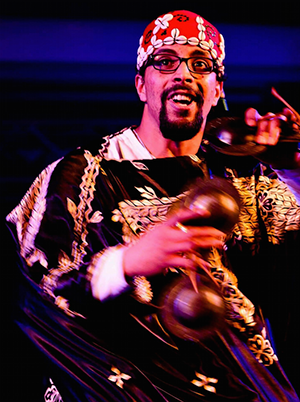
Mâalem Mokhtar GANIA
18.08.2018 | 8.30pm
The highlight of the last day of the festival is the concert by Mâalem Mokhtar Gania (Morocco), son of the legendary Moroccan musical family Gania, who can trace his family history back to Mali. The multi-instrumentalist learned the art of Gnawa music from his father Mâalem Boubker Gania and his brother Mâalem Mahmoud Gania, who were among Morocco's most important Gnawa masters and whose musical heritage he is now undertaking.
|
|
Mâalem Mokhtar Gania is a professional musician and instrument maker. In his studio in Essaouira he makes his own Gnawa musical instruments such as tbal and guembri.
|
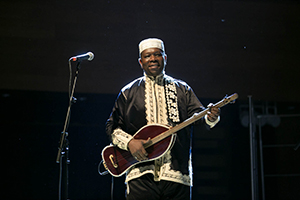
Trance of words
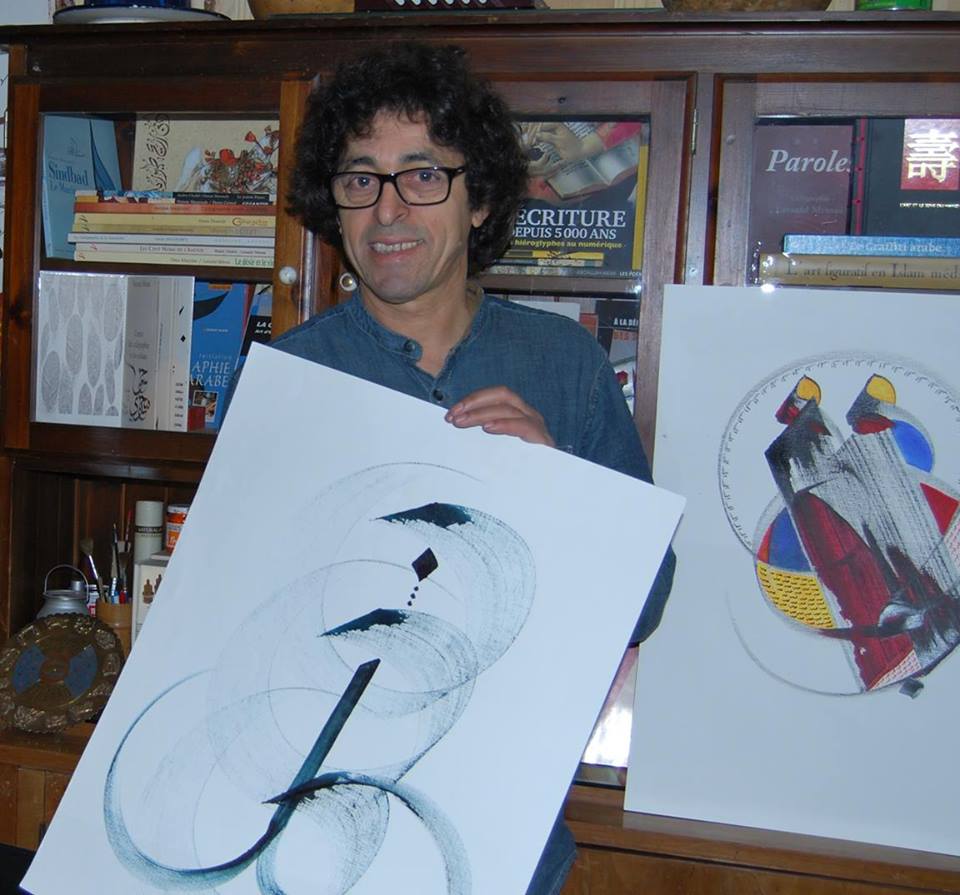
Ongoing calligraphy exhibition during the whole festival & live-performance on 17.08.18 at Simo Lagnawis concert: "Transe-graphie"
Hassan Majdi invites us to a calligraphic journey of gesture and movement of arabesque aesthetics, in which letters mix, intertwine and fly into infinity: it is truly a trance of words.
Through his artistic exchanges with other Chinese, Hebrew, Latin and Arab calligraphers, he creates unique works that have been exhibited in France and other countries since 2001. Currently, Majdi teaches Arabic at the University of Perpignan (France) and moderates international workshops and conferences on Arab calligraphy. Hassan Majdi is a French-Moroccan artist, who from the age of six was initiated into traditional Arabic calligraphy by his maternal grandfather. As a teenager, Majdi continued to practice Arab calligraphy on newspaper headlines and posters of Egyptian films. He soon settled in France, where he met the French-Iranian calligrapher Hassan Massoudy in 1995. Hassan Majdi's artistic work is an exploration of various forms and calligraphic gestures that contribute to the imparting the message of peace and love between people.
Back to Program Overview
 |
Culinary
 |
|
|
|
|
